Chapter 2
Natural Information Architecture
Order
Life is order and chaos. On its side, chaos has time; for dust we are, and to dust we shall return. Entropy is a force of nature. So we make information architecture. We use words and categories to order the world. Maps, plans, laws, and codes — our cities and towers are built with language.
The artifacts are everywhere. We make lists and forms. We embed names and structures in calendars, recipes, books, and software. These artifacts of orthodox information architecture are designed to help individuals find and understand, and to help organizations persuade and sell.
But it’s not that simple. We shape our categories; thereafter they shape us. The ways we lump and split (male-female, normal-deviant, order-chaos) are output-input. Taxonomy alters our beliefs even as it unveils them. In the strange loops of information architecture, the map is the territory. Our artifacts are the cause-effect of culture-cognition; classification is mind-bending.
E.M. Forster says, “how can I tell what I think till I see what I say,” and the world tilts. Normally we act as if reality is simple. We organize the universe objectively by carving nature at its joints. But it’s not that simple. Categories are the doors of perception. So the design of mental models and the design of shared information environments are not two. How we classify the world is a key to understanding the organization of ideas in the mind. So let’s study the artifacts of order.
Object
Most organization is personal. As children, we are told to tidy up. As adults, we sort the garage or kitchen. In these formative experiences, the objects are obvious. In the toolbox, it’s the tape measure, hammer, and screwdriver. In the silverware drawer, it’s the knives, forks, and spoons.
So it’s understandable in professional contexts when folks assume the objects, dive straight into organization, and then drown in a confusion of tongues. For example, let’s say a user experience consultant is hired to organize a website. They assume the webpage is the object. But when they meet the clients, all hell breaks loose. People speak of content items, digital assets, chunks, style guides, design systems, data models, APIs, funnels, CTAs, conversions, and touchpoints. People in content, design, marketing, and engineering all speak different languages, and the objects of organization vary by function. In all this babel, one thing is clear — there is no obvious object.
This insight translates into the design of mental models. To answer a problem creatively, it may help to question the objects. Is this the best scale or granularity? What are the irreducible units from divergent perspectives? Is the boundary that distinguishes each object fixed or fuzzy? The object is a tricky subject, hard to pin down, like a butterfly. So we will loop back to objects soon.
Organization
Before we go on, an interlude is in order. As we study the artifacts of organization, it’s useful to distinguish principle, structure, and order. An organizing principle is the logic used to lump and split (by shape, size, color). An infinite variety of principles exist on an ambiguity spectrum from objective (date, weight) to subjective (topic, task). An organizing structure is the shape or type of relationship (hierarchical, sequential). Last but not least, the sort order is the arrangement of objects or categories within a structure (alphabetical, chronological). The word hierarchy may refer to structure (taxonomy) or order (importance) or both together.
These facets are nested. Often, we choose a principle first, a structure to hold it, then an order to traverse it. For instance, we might organize mushrooms by habitat (principle), place them into a taxonomy (structure), and within each category, list the species by ascending toxicity (order). Any principle may be used for sort order, and each artifact of organization is the product of a unique mix of principle, structure, and order.
In this chapter, the artifacts are ordered from simple to complex, which correlates inversely with popularity. Humans favor simple explanations or models, even when complex alternatives are more accurate. This preference is not entirely rational. As complexity increases and confusion ensues, our reactions are emotional and aesthetic. When science reveals categories to be continua (race, sex, species), people may feel anger or disgust. Our simplicity bias reflects a useful yet dangerous tradeoff of fidelity for efficiency. As you read on, pay attention to your responses to complexity.
List
A list, or series of items, is as simple as it gets — so familiar, it’s invisible. But to take lists for granted is a mistake. Lists make civilization possible. We invented writing to make lists. The world’s most ancient written artifacts are cuneiform and hieroglyphic lists used by scribes to record transactions. Receipts, inventories, contracts, calendars, laws, censuses, tax records, property records, and payrolls are but a few of the lists we use for the administration of society.
Each list is a synthesis of principle, structure, and order. A grocery list is an ad hoc category of stuff I need to buy (principle) rendered sequentially (structure) by section or by aisle (order). Personal lists are practical. They remember, so we don’t have to. Public lists may be persuasive. By establishing categories, boundaries, and priorities, they define what counts and who belongs.
That lists are useful is obvious. That lists shape perception is not. But the list of cognitive biases generated by lists is long. A list forges an in-out boundary and an illusion of false completeness. We are blind to the un-listed. Items on a list are divorced of context and reduced to symbols. On an ancient Sumerian clay tablet, all goats are rendered equivalent for the purpose of accounting.
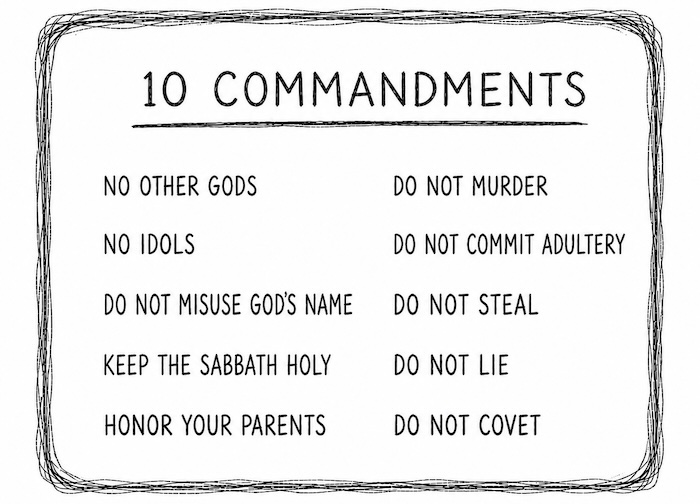
To counter bias, ask questions. What is the principle of inclusion? What is excluded and why? Is a list the best (or only) way to structure this information? How is the list ordered? Does any item stand out as different? Which one of these things is not like the others?
In the case of a checklist, keep an eye on the goal, since lots is lost in compression. For instance, when I write instructions for caring for our animals while I’m away, I am aware of all the details that don’t make the list. But the person who uses the list is not. So I ask them to keep their eyes open and stay aware of the goal — to make sure our cats, chickens, goats, donkeys, and llamas have food and water and are safe from predators, so they are happy and healthy when I return.
Category
Still waters run deep; categories run deeper still. The ways we lump (group by similarity) and split (divide by difference) are central to perception, thought, memory, language, culture, identity, and consciousness. I categorize, therefore I am. Powerful currents lie deep beneath the surface. Older and richer than words, the categories of the unconscious are entangled with our mental models. The category of gate includes the concepts of entry, exit, enclosure, exclusion, and swing open and shut. Our categories are embodied and dynamic — and change (with) us.
A category is a meaningful grouping. Its members may (or may not) be similar or related. The grouping may (or may not) serve a purpose. A pile of rocks is not a category. Until it is. Fish is obviously a category. Until it’s not. The definition of category is fuzzy, an enlightening irony.
A set of categories is a classification. The simplest classification is binary. A single distinction creates two poles: in-out, us-them, and order-chaos are opposites that co-arise. Classification requires selection of an organizing principle and granularity. If we organize by color, we must define our list of color categories. How many? What are the names? Where are the borders?
Aristotle said a category is defined by its essence and that to define man as the “rational animal” captures the uniqueness of what it is to be human. This idea of categories as objective and stable with well-defined boundaries has dominated ever since. But to blame the philosopher is unfair. This naive belief in the bounded set is natural — a symptom of our congenital simplicity bias.
Wittgenstein used “games” to show most categories are fuzzy, with a center and periphery but no clear boundary. Some games involve skill, others luck, most you can win, some you cannot. There is no essence common to all games. The category is stitched together by overlapping similarities and family resemblances. We can’t define a game, but we know it when we see it.
Rosch empirically validated Wittgenstein, showing we categorize objects based on similarity to ideal or prototypical examples; and membership is graded, and borders are fuzzy. For instance, the carrot is a prototype or central member of the category, vegetable. A cactus is a peripheral member. A mushroom may or may not be a member, depending on the classification scheme. Natural categories are rarely bounded. They contain no defining essence. Aristotle was wrong.
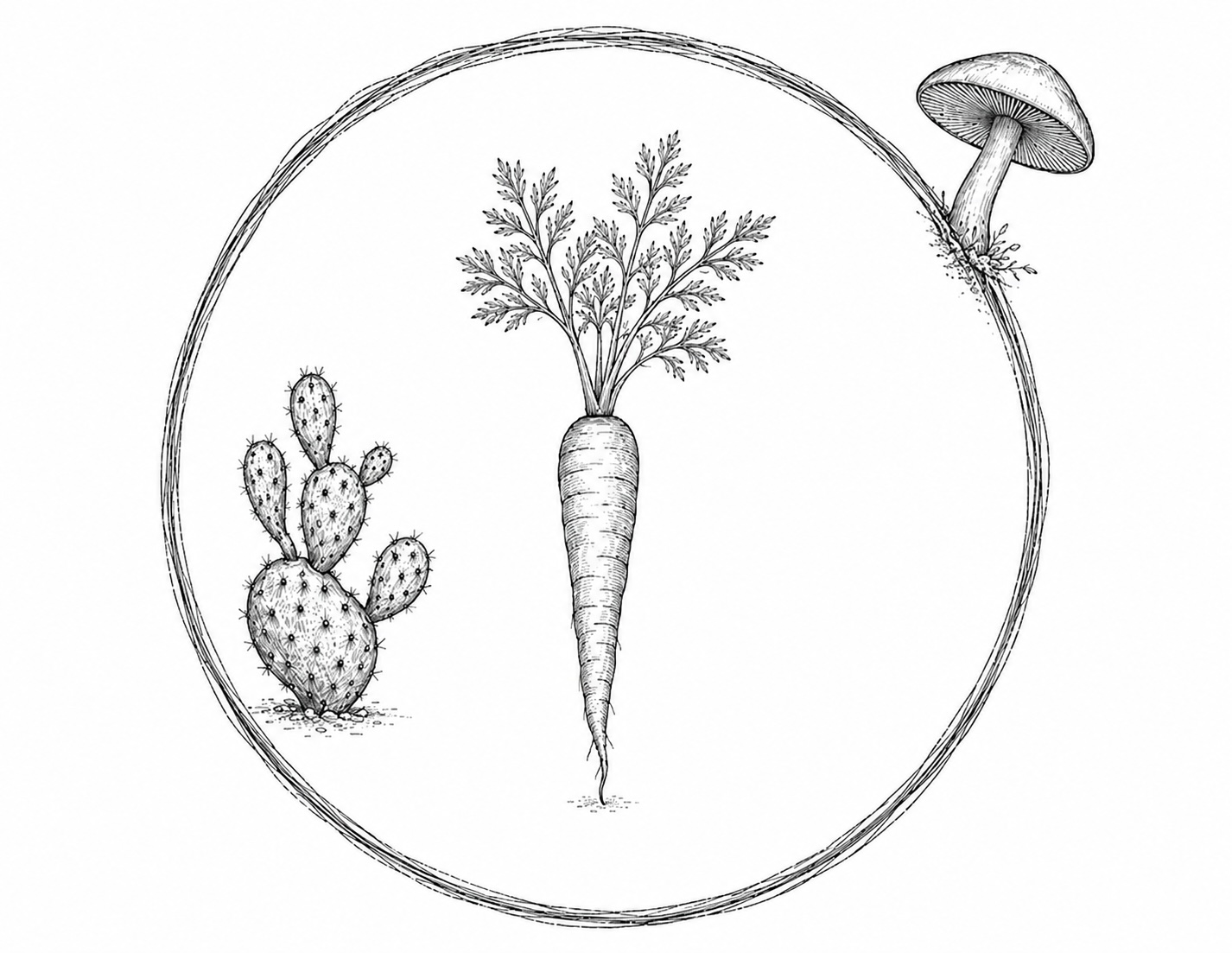
So are we. All the time. Categories are the map we mistake for the territory. To bring order from chaos, our brains lump and split. This is not optional. We can’t not categorize. Our tendency to perceive, remember, think about, and act upon individuals and instances as members of groups is innate. Our categorical bias prejudices us to exaggerate similarities within sets and differences between sets. We turn fuzzy edges into fixed borders. We collapse continua into polar opposites. We trade accuracy for speed, as fitness beats truth, and evolution favors survival of the splitters.
Categories make it hard to color outside the lines. We are trapped in cages of our own invention. But the lines don’t exist. This insight is a key to unlock creativity. When we invert, merge, soften, or reframe categories, we change what’s thinkable. We might replace categories with continua, or investigate errors and edge cases within a category, or search for similarity across categories.
Light, magnets, and electricity were discrete categories prior to 1865 when James Clerk Maxwell published a unified field theory of electromagnetism. Physics experiments revealed inexplicable relationships and similarities across categories — electricity produces magnetic fields, magnetic fields can rotate the polarization of light, and electromagnetic waves travel at the speed of light.
Maxwell realized electricity, magnetism, and light are manifestations of the same phenomenon. We now see that radio waves, microwaves, infrared, visible light, ultraviolet, x-rays, and gamma rays are frequencies or wavelengths on a single electromagnetic spectrum. This unification of categories generated a paradigm shift in physics, enabling countless scientific discoveries and technological innovations. To redefine or reimagine categories is to transform what is possible.
Taxonomy
The taxonomy, or hierarchical structure of categories, is popular because it offers a simple, scalable way to organize knowledge. A taxonomy is a tree structure that starts with a root and recursively divides categories into nested, branching, parent-child relationships. A grocery store is divided into departments, aisles, and products. A computer is organized into files and folders.
In a classic taxonomy, each child has one parent, and inherits the properties of that parent. For instance, wolves and sheep are mammals, so we know they are warm-blooded animals with four-chambered hearts who make milk to feed their babies. But we often permit polyhierarchy, which means a child may have multiple parents (which complicates inheritance). For instance, in a grocery, tortillas may be in the bread and international aisles, and the refrigerated section.
A ranked taxonomy has a fixed number of named levels. For instance, the postal service may require country, state, and city with no room for province, county, or anything else in between. In contrast, we mostly organize our computers with unranked taxonomies. If any folder at any level has too many files or folders, we can use sub-categories to create new, un-named levels.
The Linnaean classification is a familiar example of a ranked, mono-hierarchical taxonomy. Its named levels are kingdom, phylum, class, order, family, genus, and species. Each species exists in one genus, each genus in one family, and so on. In 1758 in Systema Naturae, Carl Linnaeus named three kingdoms: animal, vegetable, mineral. The organizing principle is visible structural similarity (morphology, anatomy), so bacteria are animals and mushrooms are vegetables.
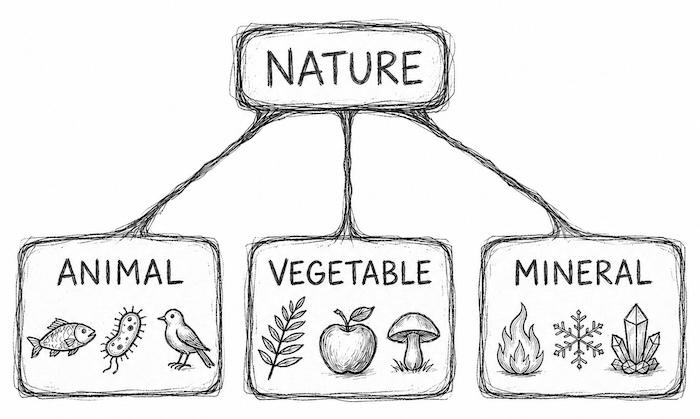
Since then, the biological taxonomy has changed. Evolution replaced divine creation as the way to explain the diversity of life, so the organizing principle is now common ancestry. A new rank of domain (archaea, bacteria, eukarya) was added above kingdom. Fungi were separated from plants. But the essence of the biological taxonomy that’s taught in school today is still Linnaean.
A taxonomy is the embodiment of a paradigm. Its tendency to endure is both promise and peril. Its construction involves countless judgements. Many decisions are wrong, or at least not right. We encode our assumptions, beliefs, and goals; then release it into the wild. At first, folks resist. But soon, it’s just the way it is. All motives and verdicts are rendered invisible. It gets embedded into systems and grows too big to change. We shape our taxonomies; thereafter they shape us.
To escape the paradigm, ask questions. What is the organizing principle of this taxonomy? Who made it, when and why? What is grouped as similar, or divided as different, that isn’t? Who does it help or hurt? What if we flatten or deepen the hierarchy, or try diverse organizing principles? The objective is to break the illusion that the taxonomy is stable, complete, neutral, and natural.
Facet
In faceted classification, objects are described by multiple independent attributes (facets) that can later be combined by the user to filter search results. In the 1990s, we had a hard time conveying this concept to clients who saw the single monolithic taxonomy as the one right way to organize websites. Our attempts to explain the paradigm shift from categorization (put objects in buckets) to tagging (describe objects in multiple ways) were met with blank stares.
But when faceted search thrived in e-commerce, the value of filtering by combinable attributes (product type, brand, price, rating, color, size) became obvious. Since a faceted classification is easier to use and manage at scale, the monolithic taxonomy faded and facets became ubiquitous.
Of course, faceted classification is not without bias. To select, label, and order facets is to wield invisible power (define which attributes matter and what users find) and foment reductionism (break wholes into parts, hide relationships) and conjure illusions of completeness (what you see is all there is). Combinatorial overwhelm makes it difficult for us to notice what’s not there.
Yet facets are paths to freedom. Our default is a list, category, or taxonomy. That’s usually how we organize ideas in the world and in the mind. Faceted classification is unnatural. It’s abstract and analytic. But if we override our aversion to complexity by exploring orthogonal dimensions, these multiple categorizations loosely held may surface the analogy that triggers the insight.
Spectrum
A continuum is the underlying territory of seamless variation, whereas a spectrum is a map of that variation. A rainbow is a continuum of light that we perceive as a spectrum of colors. The words are interchangeable, yet the map-territory distinction is worthwhile. When we define a spectrum, we often reduce multi-dimensional reality to a single axis. IQ (intelligence quotient), for instance, is a one-dimensional map of the multi-dimensional territory of cognitive ability.
In reality, these distinctions are muddled. Is autism spectrum disorder (ASD) a continuum? Is the spacetime continuum a map or the territory? These questions broach a complexity that induces confusion and frustration. So most of the time we make categories of spectra-continua.
But there is value in going the other way. For instance, the classic male–female binary can be deconstructed into multiple spectra, such as biological sex, gender identity, gender expression, and sexual orientation. Furthermore, biological sex is a continuum with multiple dimensions, including chromosomes, gonads, hormones, and anatomy. Reframing categories as continua can defuse bias and spark innovation by revealing seamless variation across multiple dimensions.
The Sorites paradox explores the gap between categories and continua — imagine a heap of sand from which grains are removed one by one, and identify the point at which the heap is not a heap. It is impossible, because words are categories; and as continua reveal, the boundaries are fuzzy.
Yet spectra induce bias too. For instance, the left-right political spectrum reduces the complex reality of political beliefs into a single line with opposite poles. And spectra make change seem smooth, so we miss thresholds, tipping points, and phase transitions. Ocean temperature and acidity are continuous variables, but coral reef collapse is nonlinear; it happens all of a sudden.
To solve problems creatively, toggle. Use categories to find thresholds and spectra for nuance. For any spectrum, ask if the metric is meaningful; and, why this axis, which pole gets neglected, and which facets are veiled by this binary? All maps are traps. The way to escape is variation.
Diagram
A model is a simplified representation of an object, system, process, or concept. Every artifact of order in this chapter is a model. Our bias has been linguistic, so let’s turn our eyes from models made of words (list, taxonomy) to the visual, symbolic models we call diagrams (map, graph).
A well-crafted diagram borders on telepathy. In the blink of an eye, a diagram can transmogrify an insight arising in one mind into a mental model embodied in the minds of many. The image of the insight is mainlined into memory. We shape our diagrams; thereafter they shape us.
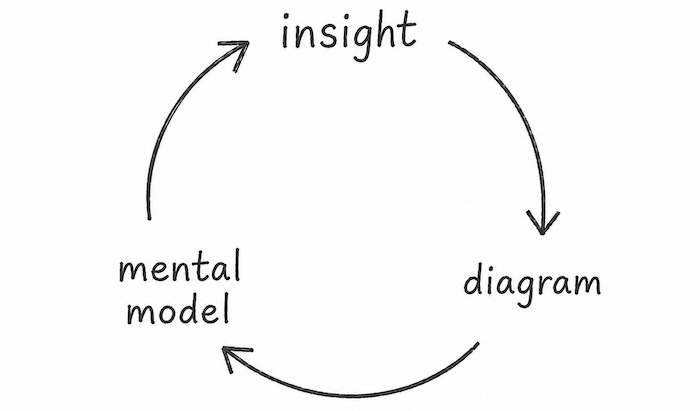
The diversity of diagrams is mind-boggling. There are diagrams for every question (who, what, when, where, why, how) and all dimensions (spatial, temporal, conceptual, relational, causal, functional, statistical). Diagrams are popular and useful, but don’t forget — all maps are traps.
The spatial map is the most ancient of models, etched into dirt, wood, stone, and bone by our hunter-gatherer ancestors since time immemorial. Used for wayfinding and marking territory, maps compress space into usable form. In so doing, they bias our minds by making select scales, orientations, centers, paths, places, borders, and threats appear natural, important, and fixed.
To model the temporal dimension of spacetime, we use clocks and calendars. Our time is linear, uniform, measurable, and schedulable. In contrast, Indigenous people may experience time as a cycle, spiral, or network of ancestral relationships. In reality, time is neither a river that flows in one direction nor a lake where past-present-future coexist, because the map is not the territory.
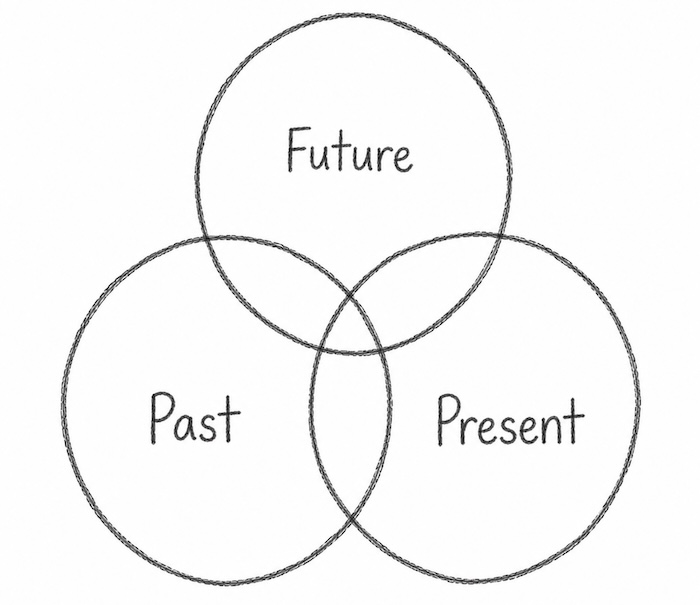
A Venn diagram is conceptual and relational. It says which categories exist and draws attention to overlap. A fishbone is causal, guiding root cause analysis by asking five whys. A flowchart is functional and explains how a system works. A bell curve is statistical. It helps us to understand and predict variation, showing how traits such as height cluster around a central average. But it misleads us too, as many phenomena (wealth, book sales) don’t follow a “normal” distribution.
Diagrams exist in all shapes and sizes. Yet, in most contexts, we limit ourselves to the first one that comes to mind. For the sake of simplicity, we fall into the trap of the map. This is okay for trifles and trivia, but to understand or solve an important problem, it is worthwhile to imagine and experiment with multiple models. All paths to creativity are exits off the one right way.
Narrative
Behind every model, there lies a story. For instance, most of us were taught the law of supply and demand, the foundational economic theory that prices are determined by the interaction of buyers and sellers. As prices rise, supply rises and demand falls, and vice versa. So markets find an equilibrium where supply equals demand.
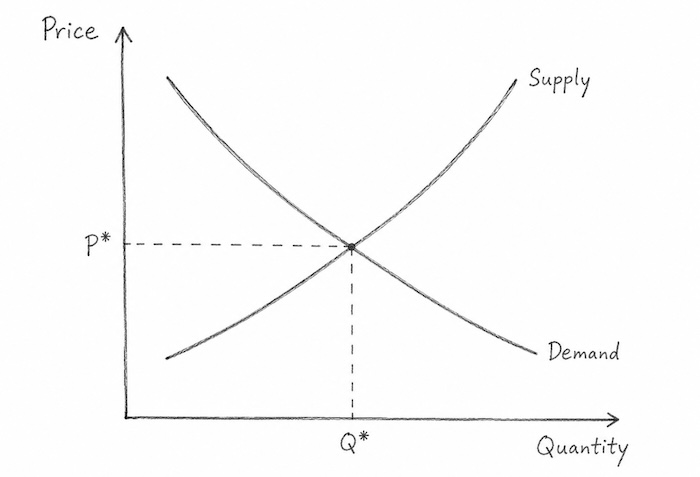
If the story is good, we buy the model. The image is implanted in memory. What we miss are the invisible assumptions. In this case, the model assumes every buyer and seller has perfect access to all relevant market data, competing products are identical, monopolies don’t exist, neither do externalities, and people always act rationally. Every single narrative hides more than it reveals.
As an artifact of order, a story is a sequence of events in which a character chases a goal, endures conflict and change, and finds meaning. For instance, one morning while I was in the forest with our goats, Eva charged and blindsided Peppermint. While goats often butt heads, this broadside was unusually violent. Peppermint seemed okay at the time but the next day, she was stumbling.
Our vet came, and after agreeing Eva injured Minty, she prescribed an anti-inflammatory pain reliever. But the very next day, Peppermint went blind. Horrified, I called the vet. She changed the diagnosis to goat polio, a deadly neurological disease. We put Minty in the car and raced to the clinic for a thiamine injection. A day later she was back to normal; it was a medical miracle.
So I had to change my story. Peppermint got blindsided, because her vision was already failing. Normally she would have evaded the charge. And our beloved goat nearly died, because we were blinded by my original story, which wove symptoms into a compelling narrative that was wrong.

Ever since, I resist the urge to fix on a story. Instead, I probe for more signs, symptoms, and stories. I seek divergent ways to explain the evidence. Goat polio taught me a valuable lesson.
Story is not merely an artifact; it’s also how we think. Our inner story is a retrospective causal stream of consciousness — made of words, images, emotions, and abstractions — that selects and arranges events and experiences into a coherent sequence. Story is how we cultivate self.
As characters in our own stories, we are subject to confabulation (our unconscious invents false memories) and apophenia (we perceive meaning in chaos). We spin reality into story, warping probability, causal reasoning, and memory. We are unreliable narrators, even to ourselves.
Still, of all our artifacts of order, story is the most ancient and powerful. Our narrative models justify the legitimacy of government, define the identity of culture, bind morality to religion, and coordinate belief and action across entire populations. A story is a trojan horse for wisdom.
Consider, for instance, the mythic narrative of the Tower of Babel.
Now the whole earth had one language and the same words. And as they migrated from the east, they came upon a plain in the land of Shinar and settled there. And they said to one another, ‘Come, let us make bricks and fire them thoroughly.’ And they had brick for stone and bitumen for mortar. Then they said, ‘Come, let us build ourselves a city and a tower with its top in the heavens, and let us make a name for ourselves; otherwise we shall be scattered abroad upon the face of the whole earth.’ The Lord came down to see the city and tower, which mortals had built. And the Lord said, ‘Look, they are one people, and they have one language, and this is only the beginning of what they will do; nothing that they propose to do will now be impossible for them. Come, let us go down and confuse their language, so that they will not understand one another’s speech.’ So the Lord scattered them abroad from there over the face of all the earth, and they left off building the city. Therefore it was called Babel, because there the Lord confused the language of all the earth; and from there the Lord scattered them abroad over the face of all the earth.
Babel is a short story with long legs. Fear of chaos drives people to order. Diversity is sacrificed on the altar of unity. Imperialism is the spawn of technological hubris and tribalism. The tale of the tower is a warning, as relevant today as it ever was. In modernity, we reach for the heavens with artificial intelligence, striving to harness the centralizing force and homogenous worldview of a large language model to reverse the curse, reinstate a common tongue, and exert dominion.
The wisdom of the story is timeless — it warns the dream of unity (one people, one language) is dangerous and must be tempered by humility and diversity. Our enduring thirst for uniformity is a symptom of simplicity bias; confused by complexity, we covet ease.
Yet there is virtue in the hard work of plurality. Within a society, diversity amplifies creativity and resilience. Similarly, as individuals, each of us can boost our ability to understand and solve problems by exploring a wide range of mental models with divergent information architectures.
If the artifacts in this chapter are ordered from simple to complex, and this correlates inversely with popularity, narrative is the exception to the rule, as it’s both complex and popular. This anomaly is possible because story is a hollow wooden horse. Its simple exterior soothes the conscious mind, while complex artifacts of order are smuggled into our unconscious under the cover of darkness.
A story invokes and encodes countless artifacts of order, including objects, lists, categories, taxonomies, facets, spectra, diagrams, and narratives; which run the gamut from simplistic binary pairs (good-evil, man-woman) to sophisticated hybrid structures (science, religion).
The sum total of our artifacts of order is culture. Like story, culture draws power from elements unseen. This is not bad. It binds people together. But it does create blind spots and constrain the space of possibility. Both story and culture dwell at the intersection of past, present, and future. The wisdom of yesterday infuses our consciousness in the present and shapes future behavior.
To solve problems creatively, especially in liminal times, we can deconstruct story-culture into its constituent artifacts of order. For any story, tradition, or ritual, question the artifacts. What are the principles of organization, structure, and order? Where are the boundaries? Who gets excluded? What are the underlying values and assumptions? And we can refigure or replace artifacts to reframe. If we reverse the order of a list or shift category into continuum or turn story into diagram, what bias or connection might we see now that was once invisible?
The practice of information architecture invents strange loops. The unconscious mind detects a pattern in nature. Arising in the conscious mind as an insight, this generalization is translated into language and becomes a category in the world. Its center and boundary shape all who enter. Not even its creator escapes the spell, for a category once imagined can never be unseen.
To oppose chaos, we impose order. Upon the foundation of language and classification, we build cities, towers, religions, governments, and cultures. We reify abstract ideas into legible artifacts and tangible objects. We turn maps in our minds into territory in the world, and it feels so natural.
0 1 2 3 4 5 6 7 8 9 10 11 12 13 14 15 16 17 18
A chapter from Natural Information Architecture by Peter Morville