Chapter 3
Natural Information Architecture
Nature
This is God’s country. As I admire the Sierra Nevada from the north wall of Yosemite, I see the meaning of heaven on earth; it’s breathtaking — so beautiful, it hurts. It’s the spring of 2001, and the past few months were hard. We had to lay off 40 people and close our company, Argus. Suffering a bad knee, I feared I’d be unable to hike. Yet I climbed 135 switchbacks with no pain; a miracle wrought by my escape to nature.
An old word with new meaning, nature or natura in Latin was originally defined as an inborn trait or essence (human nature, the nature of reality). But through the agricultural, scientific, and industrial revolutions, nature came to signify the nonhuman world. This paradigm shift split our universe into binary pairs (culture-nature, civilization-wilderness, natural-artificial). Civilization is our default. Wilderness is where humans go when we dare to go out into nature.
This ostracism of humans from nature is unnatural. Our ancestors were integral to nature for eons. That’s why there is no equivalent word in Ojibwe, Māori, or Yolŋu. Our cultural and linguistic self-exile makes no sense to indigenous people who know animals, plants, water, and land as kin to whom we are bound by relationships of respect, responsibility, and reciprocity.
Clearly, the words nature and natural are ready-to-hand tools for rhetoric, the art of persuasion. The naturalistic fallacy (to infer morality or what ought to be from the nature of what is) and appeals to nature (natural is good, artificial is bad) are endemic. Folks may claim war, slavery, and patriarchy as natural while framing homosexuality, suicide, and vaccination as unnatural.
As word-category, we can’t escape the power of nature, but we can be mindful. Cancer is natural. That doesn’t make it good. The classification (and worldview) are built into the language. Words are categories that invoke mental models. If we pay attention to words, we may see more clearly.
Natural information architecture is the study of patterns and principles that organize mind, body, and environment.
Words are core to classic information architecture. But, if natural information architecture is the study of patterns and principles that organize mind, body, and environment, then language is not the limit. The field extends beyond the fence. The scope is more than human. We will study patterns in nature (spirals, networks, flocks) and investigate how diverse minds (plants, fungi, animals, cells) organize and make sense of these patterns to resolve life’s hardships creatively.
Ironically, our odyssey is mediated by the English language-culture. And so, before we can see together how nature organizes information, we must sail through the cultural history of nature.
Natural Order
The scala naturae or Great Chain of Being is foundational to Western civilization. For over two millennia, this mental model of nature as a strict hierarchy — in ascending order of perfection from minerals, plants, and animals to humans, angels, and God — was a template for organizing knowledge, society, and religion; and for understanding our purpose and place in the universe.
In this ranked hierarchy, status and power are fixed. There is no evolution. Species do not change or move between levels. And within the earthly realm, humans reign supreme.
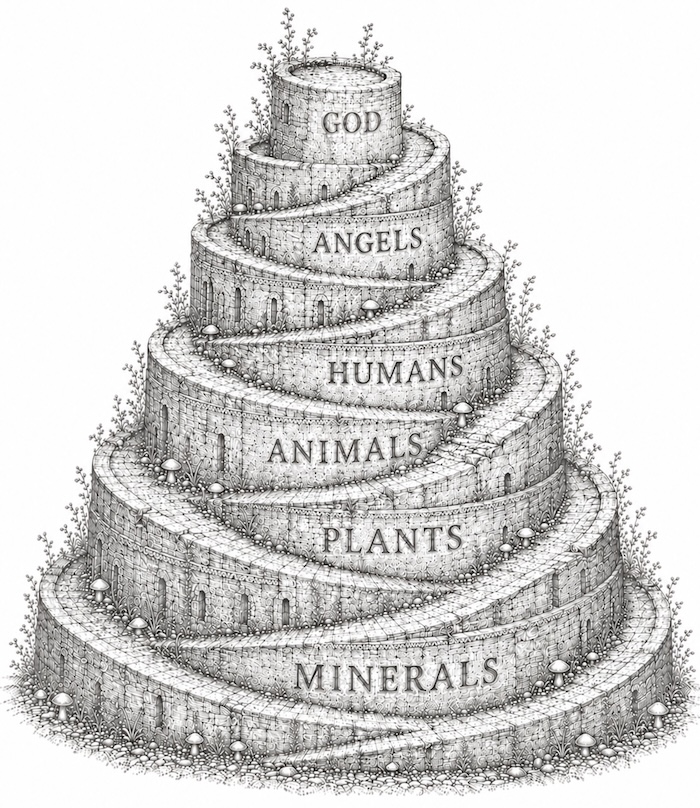
The seeds of scala naturae were planted by Plato and Aristotle and cultivated by Christianity. In Genesis, man is distinguished from and granted power over the lower animals by divine decree.
Let us make man in our image, after our likeness, and let them have dominion over the fish of the sea, and over the birds of the sky, and over the livestock, and over all the earth, and over every creeping thing that creeps on the earth.
In 1735, when Carl Linnaeus first published Systema Naturae, his classification of organisms by observable similarities and differences fit comfortably within the framework of scala naturae. In his model, species were immutable and created by God, so there was no conflict with the church.
Then came Charles Darwin. In 1859, On the Origin of Species triggered a paradigm shift that invalidated scala naturae. Darwin’s theory of evolution proposed that species evolve through natural selection. Individuals vary. Those with traits better suited to their environment are more likely to survive and reproduce. And this gradual process leads to adaptation and the emergence of new species. Darwin replaced the static hierarchy with a dynamic tree in which all organisms share a common ancestor and humans are not separate from but a part of the diversity of life.
The science has advanced dramatically since Darwin, and we now understand evolution as the interaction of natural selection, mutation, recombination, genetic drift, gene flow, epigenetics, and horizontal gene transfer; all shaped by an organism’s development and environment.
Life is not a tree. A thorny bush is a better metaphor, or an impenetrable thicket or a tangled web or a mycorrhizal network. But herein lies a wicked problem — fitness beats truth.
This conundrum bridges genetics and memetics. In evolution, organisms who perceive objective reality are unlikely to survive in competition with those optimized for fitness. In culture, truth is no match for beliefs that benefit the group. From sense to common sense, all is not as it seems.
A red apple isn’t. The apple absorbs most wavelengths of light except those we perceive as red. Neither the apple nor the light is red. The perception of color is created in the brain. We do not experience reality as it is. Everything we see, hear, touch, smell, or taste is a useful hallucination. Intellectually, we know science has uncovered this ontological truth, yet still it evades our belief.
Captive to perceptual-cognitive biases, we are wired to notice predators and prey. False positives are common. We mistake a stick for a snake. We see faces in trees. We ascribe agency to a storm. We shun the stranger who looks different. In a dangerous world, it’s better to be safe than sorry.
Perception is categorization. Awash in sensory information, the body-mind selects and classifies endlessly without our knowing. Most categorization is unconscious, and it is fundamental to life. Even single-celled organisms must distinguish helpful from harmful substances and conditions. As categorization isn’t dependent on words, language is unessential to information architecture.
This truth is obscured not only by our nature but also by our culture. We tend to think of culture in terms of artifacts (food, clothing, art, architecture, language, technology, ritual) and shared values (moral, social, political, aesthetic, spiritual), but assumptions are the bedrock of culture. These assumptions or mental models are invisible, mostly unconscious, and resistant to change.
Dominion is an assumption at the base of our culture. Western civilization is built upon the premise of human supremacy. We hold these truths to be self-evident, that animals exist for man, property is a natural right, and nature is an externality. Despite the advance of science, in all ways that matter, we continue to act as if the hierarchy of scala naturae is the natural order.
Increasingly, culture and science are at odds. Culture is comfort; we tell ourselves stories that make us feel good. Science is indifferent; it cares not a damn whether the truth is inconvenient. Earth is not the center of the cosmos. Humans are not the apex of creation. Space and time are unified and relative. Light exhibits wave-particle duality. Quantum objects may be entangled in superposition. Fish do not exist. These revelations are unsettling. Reality defies common sense.
Denial is a popular response. A thicket is impenetrable, so we cling to the tree of life. Evolution decenters man and God, so a third of us believe in creationism. If climate change is man-made, we ought to change our ways, so half of us deny the science. We opt for mental models that are simple and comforting without being conscious we made a choice. And any attempt to change a mind must navigate the Scylla and Charybdis of complicity and confrontation; too gentle won’t move the needle, while too fierce makes the heels dig in. All too often, we believe what we want.
The trick is to mind the gap. To the extent we are aware of the chasm between map and territory, we may emancipate ourselves from mental slavery, and see the universe anew with shoshin or a beginner’s mind. Culture sires one right way. Nature begets diversity. An eye isn’t the only way to see. A brain isn’t the only way to think. And, humans are not the only information architects.
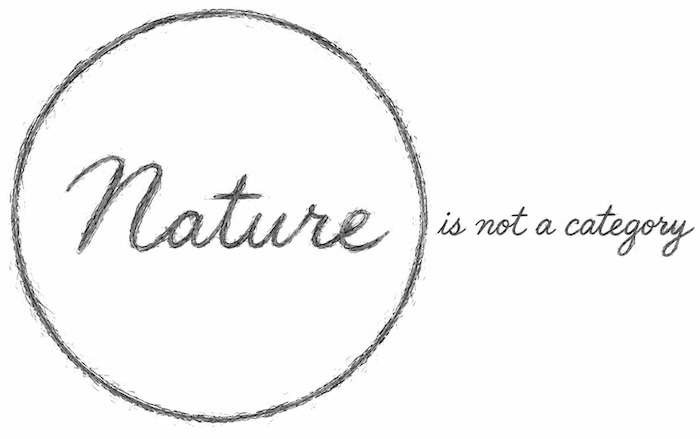
Our obsession with language and rationality as proof of human supremacy and exceptionalism has blinded us to the possibility of natural information architecture. The study of patterns and principles that organize mind, body, and environment isn’t exclusive to man. As this is not a pipe, nature is not a category. There is no outside. The wisdom of no escape can free our minds to experience the universe as a blooming, buzzing confusion of information and architecture.
Information
In culture, information is content; it’s what information architects organize. In nature, by way of Gregory Bateson, information is a difference that makes a difference; it’s that which informs a perceiver. So a book that’s never read is not information; nor is a book that’s already been read.
This take is so strict as to be silly. So let’s say it’s a difference that might make a difference. Now a book is information with or without a perceiver. But so is a rock. Any object, substance, event, quality, pattern, relation, process, thought, or feeling detectable by the senses has the potential to inform. Environment is information.
Imagine for a moment what it’s like to be a gray fox. As the forest softens into dusk, you are a shadow in a world of shadows. The scent of an appalachian cottontail draws you into a thicket. Muzzle and foreleg whiskers guide you in the dark. Alas, the tiny rabbit escapes in dense brush, and you move on. Past the old oak tree, you hear rustling in tall grass at the edge of the clearing.
As you close the gap, a hundred feet or so, your right ear rotates. The cawing of crows signals coyote. But it’s half a mile away on the north side of the river. So no worries. Yet still you take notice of a nearby tree that’s climb-up-able. Once in the grass, you hear and smell your prey.
Silent as a grave, you approach from the southwest. The vole is hidden in grass, but by integrating auditory, olfactory, somatic, vestibular, and geomagnetic senses, you effortlessly construct a dynamic 3-D mental model of the killing field. You freeze, shift weight to your hind legs, spring high into the air, plunge nose-first, and emerge with a tasty meal in your jaws.
Information is interesting when it might prove useful — to a human or a fox or a cat. All three cast a mighty wide net. Cats in particular are infamous as informavores who must sample the dog’s food and water, crawl inside the dishwasher, inspect all boxes and bags, and climb every ladder. Information seeking is an evolved adaptation for survival. Yet being nosy is dangerous too. In “curiosity killed the cat, but satisfaction brought it back,” we admit both risk and reward.
Information wants a perceiver, yet conscious attention is not required. In blindsight, cortically blind individuals avoid obstacles they never consciously see. There are myriad paths from eye to brain, some of which bypass consciousness; which means mental models exist deep in our unconscious with knowledge we don’t know we know. So attention isn’t required. But is a mind? In an avalanche, as rock hits rock, is information exchanged? I am doubtful yet unsure.
What I do know is — information isn’t just for humans, and all places are made of information. To survive, animals, plants, fungi, protists, bacteria, and archaea make sense of information in their environments. So the scope of natural information architecture is the size of the universe.
A classic information architect organizes content so people (or agents) can find, understand, or use it. Here, content is used loosely to include texts, images, videos, games, people, places, ideas, data, and objects. But, if a natural information architect studies the organizing patterns and principles of mind, body, and environment, what is the content, and where is the boundary?
To see the field, we might list the categories of information — physical, chemical, biological, ecological, cognitive, social, cultural, digital — within its range. Or catalog the languages of life: chemical, electrical, mechanical, acoustic, visual, thermal, electromagnetic. Or classify nature’s content: space, time, matter, energy, process, genes, gestures, actions, thoughts, and feelings.
The endlessness of natural information architecture is exhilarating and overwhelming. No one person can study it all. Mastery isn’t an option. It’s not a school or a department. It’s neither a title nor a job. Instead, the field is a boundary object devised to help groups with different goals, languages, and practices to conspire. For this unifying work, patterns are a good place to begin.
Architecture
Patterns are recurring or recognizable structures. They exhibit regularity (consistent order in space-time), observability, or both. So a pattern may exist without an observer, and an observer may perceive a pattern that doesn’t exist. Apophenia (perceiving patterns in random data) is common, since false positives (mistaking a stick for a snake) are often harmless, while missing a real threat can be fatal. Mostly, we get it right. Mostly, intelligence is the ability to detect real patterns, and transmute them into predictive, actionable mental models in service of survival.
Nature is a universal pattern library, a cornucopia of elegant solutions to complex problems. In contrast to artificial or man-made structures, nature’s patterns have endured the test of deep time. So it’s no surprise we are wired to perceive, enjoy, recall, trust, and make use of patterns.
Patterns inspire imitation and invention. By analogy, we transfer patterns between domains. We build spiral staircases, branching taxonomies, and robotic swarms. But we ought to be wary of monkey see, monkey do. If we don’t know why a pattern works, we can’t know when it may fail. It’s good to ask: what problem does this pattern solve, under what conditions, at what cost? The winter coat of an arctic hare is a terrible strategy in Mumbai. Fitness is defined by context.
Often, the pattern isn’t the point. To a kayaker who is reading the river, a frothy foam pile may mean a deadly hole — a recirculating hydraulic that can hold a person until they drown. To the trained eye, surface reveals structure. Patterns are hints. They tell us what lurks beneath, what came before, and what comes next.
Our first pattern is the object. A baby is born with basic figure-ground perception and learns object permanence next. Bodies, faces, hands, breasts: objects are wholes and parts. A rock is solid, an onion layered. An apple has a core, periphery, and skin. A shell has an inside and out. An object exists in space as person, place, or thing. We name to reify — this is India, that is not.
Natural objects are hard not to see. As I pass an oak on the path to our barn, a heron scares off the pond, up and over the field. I see the donkeys are watching her too. And I wonder what truly exists. The pond in my mind is discrete; in reality, there is no boundary. The oak of my mind is solid; in reality, it’s quantum fields. Speaking of which, it’s hard not to see the field for the fence. But the grass is green on both sides, and the three-rail fence is porous. Once upon a time, I smoked grass, and a tree dissolved into a thousand singular leafs, answers blowin’ in the wind.
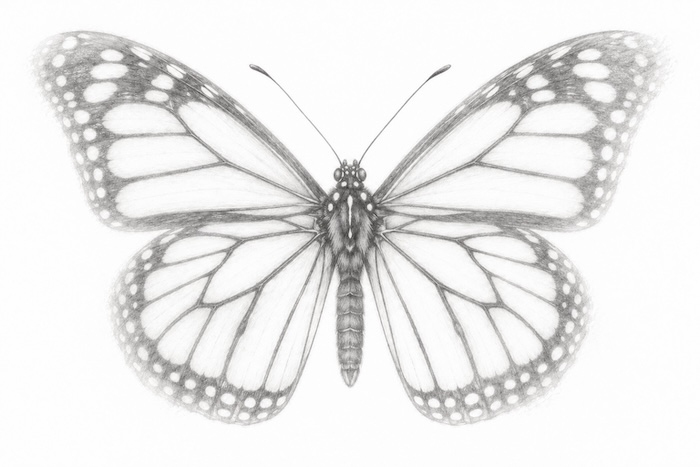
Nesting of patterns is natural. In the matrix, it’s matryoshka dolls all the way down. Among the most popular of patterns within patterns is symmetry, which arises when uniform physical and biological processes run smoothly in multiple directions. From birds and butterflies to starfish and snowflakes, bilateral and radial symmetry reflect efficiency, stability, and self-organization. In organisms, toxins, mutations, parasites, and diseases may induce the ugliness of asymmetry. As an easy-to-detect indicator of health and fitness, it’s no surprise we find symmetry beautiful.
A nested pattern that’s easyhard to spot is coloration. Stripes dissolve the object we call a tiger. That’s why leopards have spots. The puzzle pieces on a giraffe are for camouflage. They are also Voronoi tessellations, an elegant way to organize space by proximity to multiple centers. Similar patterns emerge in cracked mud, dragonfly wings, honeycombs, epithelial cells, urban planning, and the art of M.C. Escher. Tessellation is a playful way to destabilize figure-ground perception.
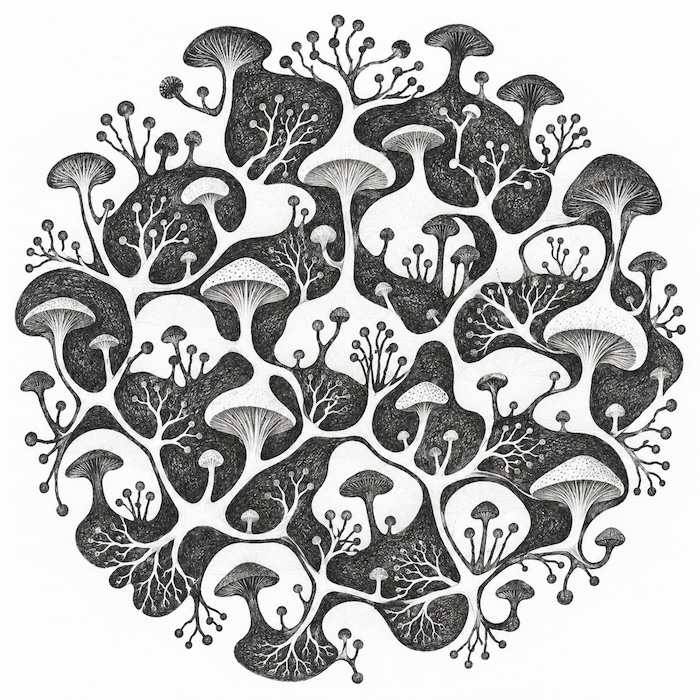
A matryoshka invokes nesting and recursion. Each mother births a child, again and again, down the generations. Each birth is an event or a pattern unfolding in time. An event has a beginning and an end; and it is bounded and sequential. There is before, during, and after. We are born, we know pleasure and pain, and we die. In the process, there is cause and consequence. A chance meeting in space makes waves in time. The airy flap of a butterfly wing is a catalyst for chaos.
A category is a cluster given a name. Stray dogs become a pack, trees a forest, flowers a bunch, minutes a life, miles a journey. The difference is fuzzy. A cluster wants proximity. A category is by affinity. Clusters exist in the world. Categories exist in the mind. Except for the natural kind — subatomic particles, chemical elements, ether, species, race — which are objective, until they are not. To say where perception ends, cognition begins invokes a boundary that doesn’t exist.
A gradient is a continuous change in a property across space-time. A cup of coffee cools on a temporal gradient, as does a sunset darkening into night. A fish who swims from ocean to river senses salinity fading on a spatial gradient, not unlike a hiker who feels the air warm gradually upon descent. A gradient is a spectrum is a continuum, unless we want to split hairs. The space from the territory of gradient to the map of category is a distance that makes a difference.
Imagine being a single-cell organism in the sunlit ocean shallows a couple billion years ago. You are awash in gradients of chemicals and energy. Hydrogen, carbon dioxide, and iron are food. Arsenic, mercury, and sulfides are toxins. You thrive in narrow ranges of temperature, pH, and salinity. It’s gradients all the way down. But your choices are categorical: keep going or change direction. I wonder if our single-cell ancestors are the origin of binary thinking (fight or flight, good or evil, us or them).
In Zeno’s dichotomy paradox, before a tortoise can walk from here to there, she must first walk half the distance, then half again, ad infinitum. By framing the continuous gradient of space as an endless set of nested categories, the philosopher makes arrival impossible. A similar what-if asks if a ship that has all its parts gradually replaced remains the same ship. We might ask the same of a self that swaps out most cells once a year. A body is a process as much as it is an object, but as the mind carves categories in nature’s gradients, we struggle to see it that way.
Claude Monet urged, “When you go out to paint, try to forget what objects you have before you, a tree, a house, a field, or whatever.” Lilies, water, and sky dissolve in a shimmering tapestry of blues, greens, pinks, and golds. The artist trades categories for a world where everything flows.
A wave is a pattern that moves. On ponds and in spacetime, ripples may or may not oscillate as they propagate with or without a medium. Light travels with energy through a vacuum, as does radio; matter is not required. Rhythm emerges in the electrical symphony of neurons; thought is a pattern moving through the brain. A heart beats and blood flows; waves are the essence of life.
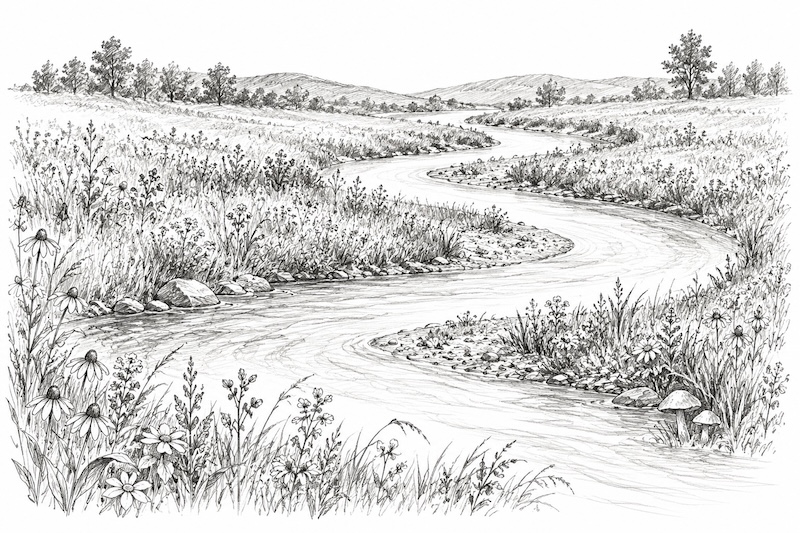
The trails worn in our pasture by donkeys are the sinuous curves of a river or a snake. Nature is able to move in straight lines but prone to meander. It’s a pattern that winds through mycelia, sand dunes, blood vessels, neurons, coastlines, thoughts, and conversations. A trace of sediment shears off the riverbank; flow quickens, erosion deepens. Slow currents on the other bank make deposits. When a river seeks the path of least resistance in uneven terrain, a meander emerges.
But that’s not the reason for the meander of a melody or a garden path. The pattern is shared, yet the forces that shape are not. The curve of a serpentine wall lends charm and stability. The dance of a song delights in discovery. The point of an odyssey is a journey that transfigures its destination. And in the twist of a line in a poem, we recall — not all those who wander are lost.
The spiral is a symbol of growth. A snail shell grows by adding calcium at its opening. As the edge rotates around a central axis, differential growth produces a spiral, often logarithmic in nature, that is sturdy, compact, and portable. The pattern invites analogy. Life is a labyrinth. Again and again we return to not exactly the same spot; and as we learn, our wisdom grows.
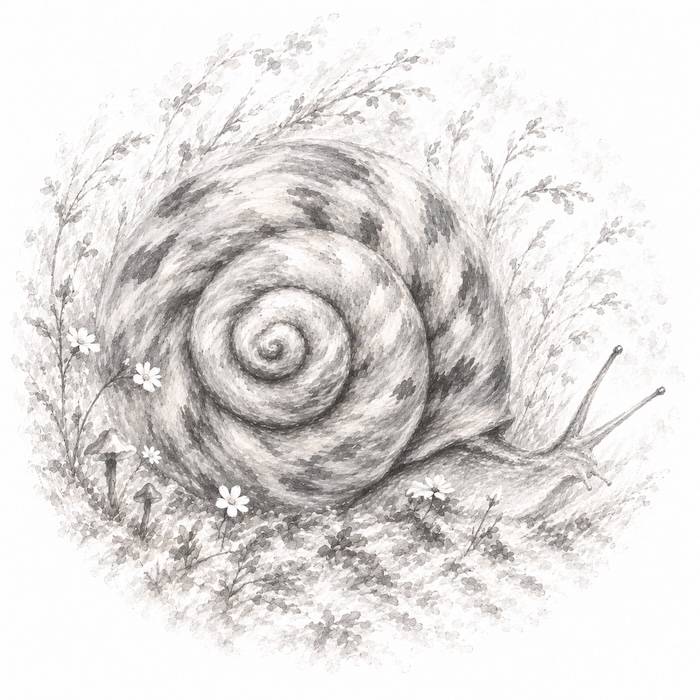
Of course, growth isn’t the only cause of spirals. A screw converts force into motion. A spiral staircase is a compact way up. A tornado forms when wind shear creates a horizontal rolling cylinder of air, an updraft tilts it vertical, and air spirals into its low-pressure center. And the turbulence in Van Gogh’s Starry Night — never shall we solve the mystery of those spirals.
The concept of hierarchy comprises three patterns: branching, nesting, ranking. To branch, one path splits or many paths join, recursively. In search of sun, a tree grows into progressively smaller limbs and twigs. Flowing downhill, a river grows as streams converge into larger and larger tributaries. Nesting invokes parts and wholes. Like a matryoshka, a plum is nested: skin, flesh, pit, seed. Ranking defines position. Chickens compete for status within a pecking order.
While these patterns exist in nature, integration is rare. The top of a river holds no more status than its bottom. So, to say the hierarchy of an org chart is natural is simply unfair. Similarly, a hierarchy may impose more than describe order. The biological taxonomy — domain, kingdom, phylum, class, order, family, genus, species — is as much a model in our minds as a pattern in the world. Branching in evolution is real; ranking organisms into taxonomic levels is our design.
A network is a web of relationships. The hyphae of a mycelial network split and join, creating a web for the transport of nutrients and signals — an embodied information architecture. As links are many-to-many, the network is decentralized, adaptive, and resilient. So it’s unsurprising to learn this pattern is ubiquitous from brains, veins, and spider webs to roads, power grids, and the Internet. Nature teaches us that it’s often better to distribute power than to concentrate it.
When demand outstrips supply, competition arises. Trees grow tall in the fight for light, while roots go deep in the war over water. Coyotes murder foxes over food and territory. Peacocks bear the weight of spectacular, iridescent trains to best rivals for mates. A zero-sum game, predation is different. Predators and prey don’t compete over resources, yet when a cheetah wins the race, the gazelle loses her life. Both competition and predation drive natural selection.
When beings act for mutual benefit, cooperation arises. The gain needn’t be equal, immediate, or intentional. Hyenas hunt in a clan but don’t always share the kill. In the exchange of pollen and nectar as bees visit flowers, the benefit is emergent — and for the flowers, delayed. Fish form schools, sheep herds, birds murmurations, ants colonies, and locusts swarms, yet these collectives require no conscious intent. The emergent whole is greater than the sum of its parts.
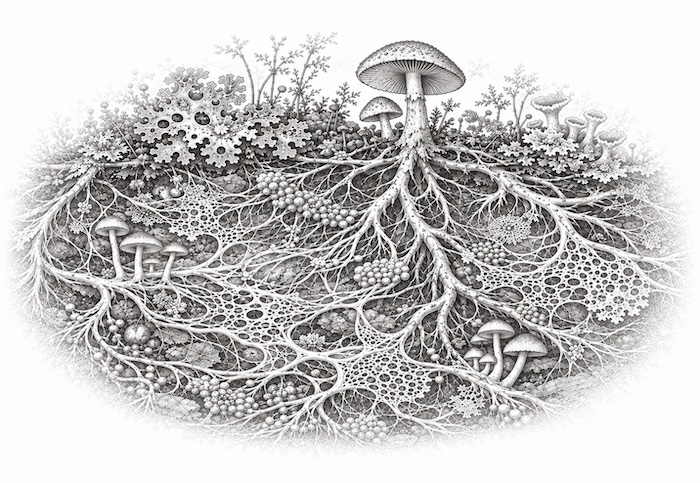
These are but a few of the endless patterns of nature. As many patterns as there are, there are even more combinations. In a mycorrhizal network, fungi, bacteria, trees, and wildflowers may shift between cooperation and competition based on the availability of carbon, water, and minerals; as the environment changes, so do the economics.
Patterns support understanding and prediction, and may hint at the architecture of the universe. But it’s wise to be wary of the is-ought fallacy. To suggest that since the organizing pattern of the lobster is a dominance hierarchy, humans ought to embrace the pecking order is bad faith.
As we use patterns for inspiration and invention, we must ask not only what but also when, where, why, and for whom. Fitness is defined by context — and context is subject to change.
Categorical Beings
In 1976, the Journal of Experimental Psychology published Natural Concepts in Pigeons, a landmark study showing pigeons can learn surprisingly abstract categories. The birds were able to identify photos with water or trees; and the nature and similarity of their errors suggest shared category boundaries shaped by what Wittgenstein called family resemblances.
A research lineage inspired by this paper reveals that pigeons form categories from patterns of similarity in the world as they perceive it. Basic-level categories (flowers, chairs) are easiest to learn, but they can also master broader generalizations (natural, artificial).
In short, pigeons categorize as humans do. The scientists confess surprise. This reveals a flaw in their mental models. In a culture of human exceptionalism, similarity comes as a shock. But, in light of evolution, it’s obvious that all life translates patterns into categories for survival. How else could wild pigeons distinguish food, family, friends, predators, and safe nesting sites?
Pigeons are a standard laboratory animal with excellent vision whose natural pecking behavior provides a clean experimental response. They were chosen for convenience, not for exceptional classification skill. In fact, the evidence suggests categorization is universal. Dogs group objects by appearance and affordance. Squirrels identify acorns that vary in size, shape, and color. Bees generalize, using linear landmarks such as roads and rivers for wayfinding. Vervet monkeys exhibit a unique alarm call and response for each predator class (leopard, eagle, snake). Prairie dogs do the same, identifying both category (hawk, coyote) and individual (big blue human).
All living organisms are categorical beings or patterns who organize patterns. Fungi, protists, plants, animals, bacteria — we are all information architects. We detect patterns, draw borders to forge categories, build mental models, make predictions, and act accordingly. And because our behavioral options are limited (fight or flight) relative to the boundless complexity of our environment, we reduce nature’s resplendent continuum of color to shades of gray, and then shades of gray to black and white.
This is not to say categorization is uniform. On the contrary, it varies by species and individual. Intelligence or pattern recognition for creative problem solving is a measure of this categorical capacity. Importantly, but not surprisingly, pattern recognition is mostly unconscious. The ability to detect and respond to useful regularities is written in brains and bodies in a language older than words.
While all organisms send and receive signals, humans are exceptional in the use of words. Our capacity for language is central to our identity. But words are spells that spotlight rationality while our unconscious runs the show. Mesmerized by the language of medicine, we fail to see what matters is invisible. A doctor tacitly identifies a cluster of symptoms to make a diagnosis. Expertise is pattern recognition forged by experience. Words are fingers pointing to the moon.
Language gives confidence to categories. As words name patterns, they reify too. This breeds hubris. We think we can predict the unpredictable. But unlike a sunrise, a storm is subject to the wings of a butterfly. Words let us say anything and categorize everything. And yet, as the only animals who imagine ourselves beyond nature, we remain subject to the limits to growth.
Indigenous Futures
In the last two centuries, life expectancy doubled, child mortality fell by 90%, absolute poverty collapsed, and literacy soared. We eradicated smallpox, reduced famine and infectious disease, expanded access to clean water, sanitation, nutrition, medicine, education, and technology, outlawed slavery, created material abundance, and extended rights, citizenship, and democracy.
While this progress narrative is true, it is also incomplete. Not only does it overlook colonialism, genocide, and inequality, but it is blind to the impact of civilization upon the more-than-human world. If we adopt a wider frame that attends to patterns in nature, we may tell a different story.
Our culture is a cancer that grows at the expense of its host. Since the advent of agriculture, our population exploded from less than 5 million to more than 8 billion. In the process, we breached 7 of 9 planetary boundaries and catalyzed climate change, ocean acidification, desertification, ecosystem collapse, and mass extinction. Since 1850, the biomass of wild mammals has fallen by 70 percent. Among humans, fertility is dropping, and pollution is the cause of one in six deaths.
Both stories are based on real patterns. The trick is to know which patterns count. My bet is on collapse. The metacrisis is a wicked problem, an emergent pattern of rivalrous dynamics and multipolar traps in which rational acts by individuals produce collective harm. The system itself resists any and all course correction, even in the face of obvious catastrophic or existential risk.
Once upon a time, my family stopped to ask directions while on vacation in Maine, and we were told, “You can’t get there from here.” This quip — which actually makes sense in a state where mountains, lakes, and rivers conspire to confound travelers — comes into mind whenever I try to imagine a better tomorrow. I have a sense of where we belong, but no idea how to get there.
You can’t get there from here.
I dream of indigenous futures. Not a return to foraging, though that may occur. I mean a time in which the illusion of separation between man and nature is dissolved and our sense of belonging is restored. I mean an era of sustainable lifeways where we are bound to animals, plants, waters, and lands by relationships of respect, responsibility, and reciprocity. I dream of a kaleidoscopic tapestry of diverse peoples who live and die knowing their children are inheriting a better world.
As a phoenix arises from the ashes, so too may novel technology emerge. But it will be subject to the moral imperative to do no harm. A society cannot advance first, and later become good. As Gandhi warned, there is the same inviolable connection between the means and end as between the seed and tree.” A better way for all of creation is possible if we move slow and mend beings.
I don’t expect to survive the fire. The assumption of dominion is the bedrock of our culture. We won’t exit the paradigm of scala naturae before I die. Even so, I am happy to be here. I do not feel cursed to live in such interesting times. On the contrary, I am fascinated to observe as the patterns of change, change. I am grateful for the liminality of natural information architecture.
0 1 2 3 4 5 6 7 8 9 10 11 12 13 14 15 16 17 18
A chapter from Natural Information Architecture by Peter Morville